

- Watch out
- What it costs
- Experienced readers
- Remember
- In BIMpedia
A drawing is never finished until the project is. Each change produces a new revision of the sheet, and on a busy project dozens of sheets change every week. Revisions and transmittals are the bookkeeping that lets anyone answer two questions with evidence: what changed, and who knew.
| Item | What it does |
|---|---|
| Revision code | Identifies the version (P01, P02… then C01 under ISO 19650 practice; A, B, C or 1, 2, 3 elsewhere) |
| Revision table | Lists every revision: code, date, description, initials |
| Cloud | A scalloped outline around the changed area |
| Triangle | A small marker with the revision code, next to the cloud |
| Transmittal | A record sent with drawings: which revisions, to whom, when, why |
A revision in its simplest form
Sheet 4 of the Benton Street Bridge was made in January 1948. Under its title block someone has written "Rev. E.J.W. 11-15-48": a revision made on 15 November 1948, initialled. There is no description, no cloud and no revision code. Almost eighty years later, that's still enough to know the sheet changed, but not what changed. A modern revision table adds exactly the missing pieces.
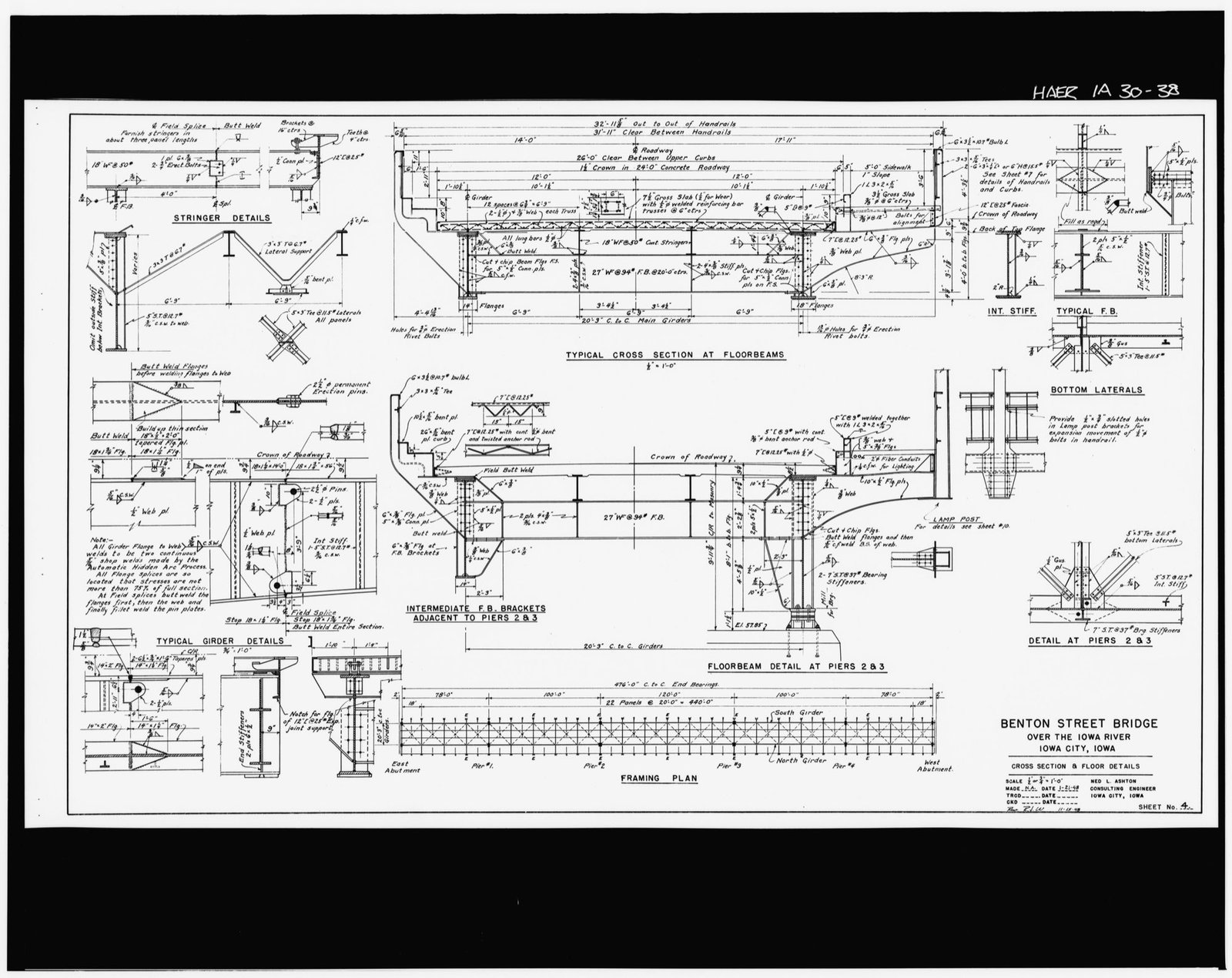
Sheet 4 again. Look under the title block for the revision line, and notice what it doesn't tell you.
Benton Street Bridge, Iowa City (Ned L. Ashton, consulting engineer, 1947–48). Historic American Engineering Record, HAER IOWA,52-IOWCI,4-. Library of Congress, Prints and Photographs Division. Public domain. Source
Reading a modern revision table
| Rev | Date | Description | By | Checked |
|---|---|---|---|---|
| P01 | 12 Jan | First issue for coordination | AB | CD |
| P02 | 03 Feb | Riser moved to grid C; door D07 widened to 1,000 | AB | CD |
| C01 | 24 Feb | Issued for construction | AB | EF |
The description says what changed; clouds with a "P02" triangle say where. Uncloudded changes happen, and deletions leave nothing to cloud, so when it matters, compare the two revisions side by side or in the model.
The steel fabricator works from C02 of the floor plan; C03, which moved two openings, was uploaded to the CDE but never transmitted to them. The beams arrive with holes in the old positions. Nobody can prove who was told what.
Every issue goes out with a transmittal listing sheet, revision, purpose and recipients, and the fabricator's acknowledgement is recorded. When C03 is issued, the register shows the fabricator received it on 4 March; the old holes are the fabricator's to fix, and the question takes one email to settle.
The contractor says the riser on level 2 was built to the drawings. The register shows: sheet M-201 P02 (riser at grid B) transmitted to the contractor on 3 February; P03 (riser moved to grid C) uploaded on 20 February but not transmitted; C01 (for construction, riser at grid C) transmitted on 1 March. The riser was built at grid B on 25 February.
- Which revision did the contractor have on 25 February?
- Was it issued for construction?
- What would you record, and what process gap does it show?
Key takeaways
- Each revision gets a code, a date, a description and initials, in the revision table or title block.
- Clouds and revision triangles mark where the sheet changed in this revision.
- A transmittal records which revisions were sent to whom, when and for what purpose.
- Superseded sheets are archived and marked, never left in circulation.